


Furnished apartment vs hotel vs serviced apartment in Seoul: total cost for three months
Choosing where to live for three months in Seoul is different from booking a short business trip. A nightly or monthly rate is only part of the com…




Choosing where to live for three months in Seoul is different from booking a short business trip. A nightly or monthly rate is only part of the comparison: kitchen and laundry access, housekeeping, utilities, deposits, workspace, privacy, and the ability to change dates can all affect the practical and financial commitment.
For a three-month assignment or relocation, compare the complete booking rather than assuming that a hotel, serviced apartment, or furnished monthly apartment will always be the cheapest option.
Key takeaways
- Hotels generally prioritize short-stay convenience and regular service, but room layouts may offer less day-to-day functionality for a three-month stay.
- Serviced apartments combine residential features with hotel-style services such as reception and housekeeping.
- Furnished monthly apartments generally prioritise private residential space and self-contained daily living.
- Compare the full three-month cost, including mandatory charges and services that are not included in the advertised rate.
- Also consider upfront cash, flexibility, space, kitchen, laundry, and support rather than choosing on price alone.
Furnished apartment vs hotel vs serviced apartment at a glance
The boundaries between these housing types are not always identical across providers. However, this framework can help you identify the main differences before comparing individual properties.
| Factor | Furnished monthly apartment | Serviced apartment | Hotel |
| Typical booking structure | Monthly or fixed rental period | Nightly, weekly, or monthly | Primarily nightly |
| Living setup | Private residential unit | Residential-style unit with added services | Room or suite |
| Kitchen | Common, but check the unit | Common | Property and room-type dependent |
| Laundry | In-unit or building facilities may be available | In-unit, shared or service-based | Often service-based or property-dependent |
| Housekeeping | Optional or provider-dependent | Commonly scheduled | Commonly provided regularly |
| Front desk or reception | Not necessarily | Common | Common |
| Utilities and Wi-Fi | Check what the quote includes | Often bundled, but confirm | Commonly included |
| Residential privacy | Usually a strong feature | Usually strong | Private room within a hotel environment |
| Support model | Property-management or customer-support team | Residential and hotel-style support | Hotel operations team |
| Best starting point for | People prioritising residential living for a multi-month stay | People wanting residential facilities plus regular services | People prioritising short-stay convenience and hotel services |
In Seoul, the Seoul Metropolitan Government describes serviced apartments as furnished apartment buildings for short- and long-term visitors that typically include residential necessities and a kitchen alongside hotel-like services such as a front desk, business centre and community area.
The term furnished apartment, by contrast, describes the residential setup more than a standardised service model. The exact level of cleaning, customer support, building facilities, and included services therefore needs to be checked with the individual provider.
What is the difference between a furnished apartment, serviced apartment, and hotel?
The main distinction is not whether a bed and furniture are provided. All three options can be furnished. The more useful question is how the home is designed to function during everyday life.
Furnished apartment
A furnished monthly apartment is a residential unit equipped for a renter to move in without purchasing major furniture or setting up an unfurnished home from scratch.
Depending on the property, it may provide a separate living area, kitchen, laundry facilities, storage, and workspace. The renter generally has more control over their daily routine, while housekeeping and other hotel-style services may be optional or unavailable.
Booking terms vary significantly. Some professionally managed furnished apartments specialise in stays of one month or longer, while other furnished rentals use longer fixed leases.
Serviced apartment
A serviced apartment combines self-contained living facilities with a higher level of hospitality service.
A typical unit may provide a kitchen and living space while the building or operator offers reception, scheduled housekeeping and shared facilities. This can make serviced apartments useful for travellers who want more residential functionality than a hotel room but still value regular on-site services.
The service level is one of the most important points to compare because the term “serviced apartment” does not mean every property provides the same cleaning frequency, facilities, or front-desk coverage.
Hotel
A hotel is structured primarily around short-term lodging and hospitality services. Guests can generally expect reception and housekeeping, while restaurants, room service, fitness facilities, lounges, and business services vary by property.
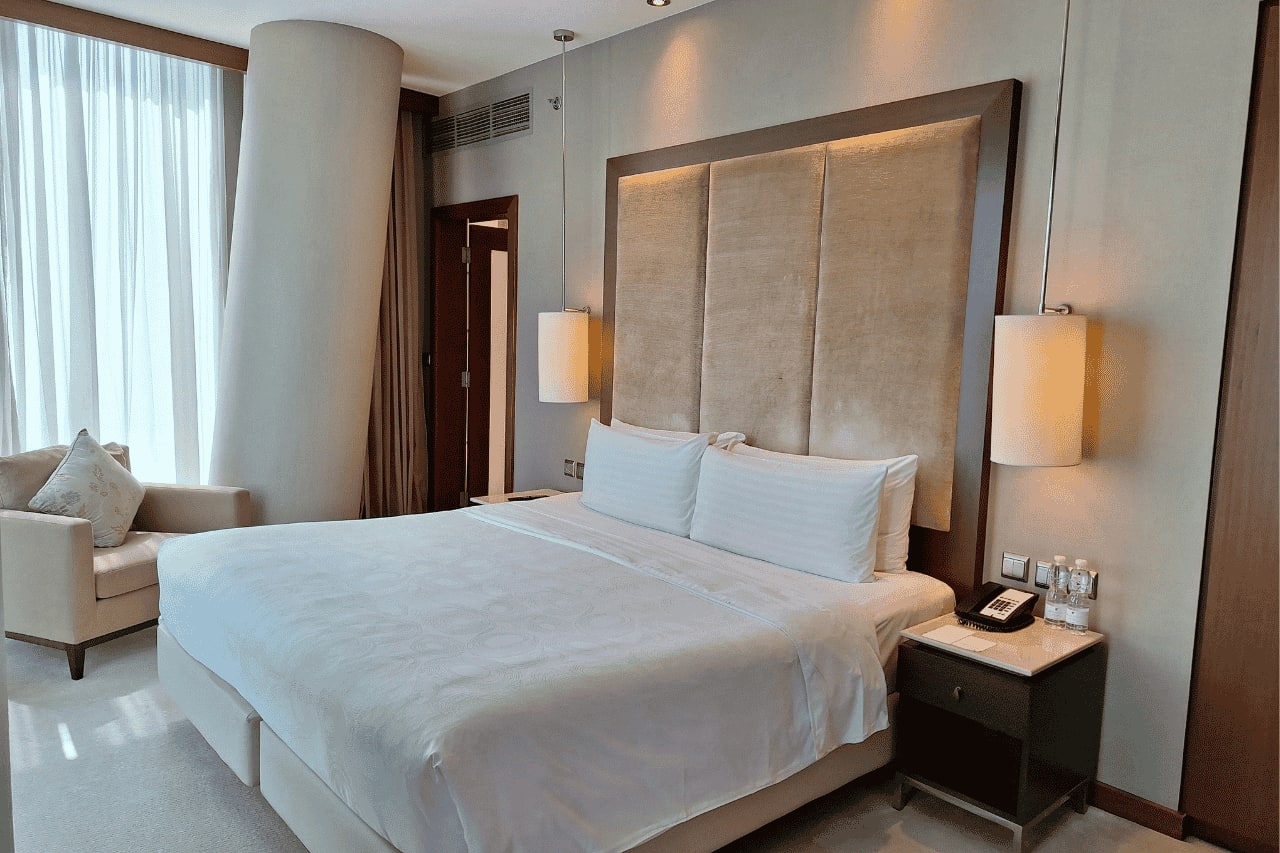
For three months, the main question is whether the selected room or suite provides enough functionality for everyday life. A conventional hotel room may work well for someone who values daily service and spends limited time at the property, while someone cooking, working remotely, or doing regular laundry may need to examine the room facilities more carefully.
How should you compare the total cost of a three-month stay?
Do not compare a hotel nightly rate with an apartment monthly rate without checking what sits behind each number.
For a useful three-month comparison, separate non-refundable cost from upfront cash required.
Calculate the non-refundable three-month cost
Start with:
Housing charges
- mandatory booking or service charges
- utilities not included
- required cleaning or housekeeping
- laundry costs where relevant
- parking or other required services
- other non-refundable charges
This gives you a more meaningful figure than the headline rate alone.
Calculate the upfront cash requirement separately
Then identify:
Initial housing payment
- refundable security deposit
- other refundable amounts
- one-time charges due before move-in
A security deposit affects cash flow, but a fully refundable deposit should not be counted in the same way as rent or a non-refundable fee.
This distinction is particularly important for corporate bookings. Finance teams may care both about the final housing expense and how much cash must be paid before the employee moves in.
What costs should you check for each option?
Use the same cost categories when requesting quotes so that you are comparing equivalent information.
| Cost or requirement | Furnished apartment | Serviced apartment | Hotel |
| Housing charge | Check monthly or full-period quote | Check full-period quote | Check full 90-day quote |
| Utilities | Confirm inclusion and any limits | Confirm inclusion | Usually bundled, but verify |
| Wi-Fi | Confirm | Confirm | Confirm |
| Security deposit | May apply | May apply | Depends on property and booking |
| Booking/service fee | Provider-dependent | Provider-dependent | Booking-channel/property-dependent |
| Cleaning | Included, optional, or separate | Often scheduled; confirm frequency | Usually included |
| Laundry | Check in-unit/building setup | Check unit or service charges | Check hotel service or facilities |
| Parking | Usually separate if required | Property-dependent | Property-dependent |
| Early check-in/late check-out | Provider-dependent | Provider-dependent | Provider-dependent |
| Extension price | Confirm new quote | Confirm new quote | Depends on future rates |
| Cancellation or early departure | Contract-dependent | Booking-dependent | Rate-plan dependent |
The purpose of this table is not to establish which category is always cheaper. It is to ensure that three quotes measure approximately the same thing.
Rent, utilities, booking fees, and cleaning fees can all form part of the total price. Exact charges vary, so they should be confirmed for the selected home and booking.
A better way to compare three options for a 90-day stay
Consider an international professional moving to Seoul for a 90-day project. They need reliable internet, somewhere to work, the ability to prepare meals, and a practical way to do laundry.
Instead of comparing three advertised rates, collect the following information for the same dates and number of occupants:
1. Get the complete 90-day housing quote
Ask each provider for the price covering the entire period rather than multiplying a single advertised nightly or monthly rate.
Longer-stay rates, availability, and conditions can change according to the dates selected.
2. Separate included and excluded services
Record whether the quote includes:
- Electricity, gas, and water
- Wi-Fi
- Cleaning
- Linen or bedding changes
- Laundry
- Parking
- Building facilities
- Taxes or mandatory charges
Something that is included with one provider may be an optional charge with another.
3. Record refundable payments separately
A larger deposit can create a significant upfront requirement without necessarily increasing the final cost of the stay.
Record:
- Deposit amount
- Deposit payer
- Conditions for deductions
- Expected refund process
- Expected refund timing
4. Compare equivalent living requirements
The cheapest room is not an equivalent comparison if the employee actually requires a workspace, full kitchen, or laundry facilities.
Define the requirements first, and compare only options capable of meeting them.

What do you get for the money over three months?
Cost is easier to interpret once you identify how the home will actually be used.
Space and privacy
Three months is long enough for layout to become a practical consideration rather than a preference.
Check whether the accommodation provides:
- Separate sleeping and living areas
- A suitable place to work
- Storage for clothing and luggage
- Space for approved additional occupants
- An appropriate dining area
- The level of privacy the renter expects
Do not rely on the accommodation category alone. Compare the actual floor plan, floor area, and photographs of the selected room or unit.
Kitchen and everyday meals
A kitchen can become more useful during a multi-month stay, particularly for people who do not want to rely on restaurants for every meal.
Check whether the accommodation provides:
- Hob or cooking surface
- Refrigerator
- Microwave or oven where required
- Cookware
- Utensils
- Plates and glassware
- Dining space
A kitchenette and a fully equipped kitchen are not equivalent. Ask what is actually provided rather than relying on the word “kitchen” in a listing.
Kitchen access also does not automatically make an accommodation option cheaper. The financial value depends on how often the occupant actually prepares meals.
Laundry
Laundry is another small difference that becomes more significant over 90 days.
Check whether the renter will use:
- An in-unit washing machine
- Building laundry facilities
- A paid laundry room
- Hotel or serviced-apartment laundry services
- An external laundromat
Convenience and price can vary substantially between these arrangements, so include the likely laundry setup in the comparison.
Housekeeping and day-to-day service
More service is useful when the traveller wants it, but it should not automatically be treated as better value.
A hotel may provide regular room cleaning, while a serviced apartment may use scheduled housekeeping. A furnished apartment provider may offer cleaning separately or on request.
Ask:
- How often is cleaning provided?
- Is it included?
- Can additional cleaning be arranged?
- Who handles maintenance?
- How are issues reported?
- Is there on-site reception or remote customer support?
The appropriate model depends on whether the occupant prefers regular hotel-style service or greater independence.
Which option is more flexible if the three-month plan changes?
An assignment described as “three months” may ultimately last ten weeks or four months.
For each accommodation option, check:
- Cancellation conditions
- Minimum stay
- Required notice
- Early-departure conditions
- Whether shortening the booking changes the rate
- Extension process
- Availability for an extension
- Price for additional dates
- Whether the same unit or room can be retained
Do not assume that a hotel is automatically more flexible because it is sold nightly, or that a monthly apartment can automatically be ended at the end of any month. Flexibility depends on the actual rate plan, booking, and agreement.
Blueground’s furnished apartments in Seoul typically have a minimum stay of one month. Eligible bookings may also be extended when additional dates are available, with pricing and other conditions depending on the specific booking.
When does a hotel make more sense for an extended stay in Seoul?
A hotel may be a sensible starting point when convenience and service are more important than having a residential setup.
It may suit someone who:
- Needs accommodation for a relatively short or uncertain period
- Values regular housekeeping
- Wants reception or concierge support
- Uses on-site dining and hotel facilities frequently
- Does not need a full kitchen
- Spends limited working or leisure time in the room
- Has a rate plan that suits likely date changes
For a three-month stay, however, check the exact room size, workspace, laundry arrangement, and full-period rate before assuming that a hotel will meet the same needs as residential accommodation.
When does a serviced apartment make more sense for an extended stay in Seoul?
A serviced apartment can suit someone who wants residential facilities without giving up regular hospitality services.
It can be worth considering when:
- A kitchen is important
- More living space than a conventional hotel room is required
- Scheduled housekeeping is valued
- On-site reception is useful
- Shared building amenities matter
- The employer wants an extended-stay format with a hospitality-style service model
The trade-off is that the renter may be paying for services they would not prioritise in a self-contained monthly home. Compare those services against the actual requirements of the assignment.

When does a furnished monthly apartment make more sense for an extended stay in Seoul?
A furnished monthly apartment may be a useful starting point when the occupant expects to live in Seoul rather than simply visit the city.
It can suit:
- Professionals on multi-month assignments
- Employees relocating while permanent housing is arranged
- Couples or families requiring more residential functionality
- People working remotely part of the week
- Renters who want their own kitchen and laundry setup
- People who value a private residential environment
- Renters who do not require daily housekeeping or a hotel front desk
The main points to verify are the exact unit inclusions, full cost, minimum stay, deposit, support arrangements, and conditions for changing the booking.
Professionally managed furnished monthly homes are generally built around medium- and long-term living for corporate professionals, expatriates, and assigned employees.
Explore more: Corporate lease vs individual lease for employee relocation in Seoul
The three options are not equivalent for tax
One line item is easy to miss when comparing cost. Where the company is paying for a three-month stay, the housing type changes how the benefit is taxed in the employee’s hands.
Housing the company leases directly and provides free of charge may be excluded from the employee’s taxable employment income under Korean income tax rules. That exclusion carries restrictions on the type of property.
- Residence-hotel accommodation does not qualify. If a serviced residence is under consideration, the tax outcome may differ.
- Shareholding executives are excluded from the exemption; small-shareholder executives are not.
- The exemption does not apply where the employee bears any part of the rent or deposit.
The practical consequence is that the same spend can produce a different net position for the employee depending on whether the stay is in a furnished apartment or a serviced residence. Comparing the company’s outlay alone will not surface that difference, so a company-paid comparison should carry this as a separate line.
Check the invoicing treatment too. Residential leasing is exempt from VAT in Korea, so a plain invoice is normally issued, while hotels and serviced residences are more often treated as taxable lodging services. If a Finance approval process assumes one document type, this needs to be resolved before booking.
Confirm the treatment of a specific arrangement with a Korean tax adviser.
This section describes general Korean leasing and tax practice. It is not legal or tax advice. Confirm the treatment of a specific arrangement with a Korean adviser.
Which option suits different types of three-month stay?
The table below is a starting framework rather than a universal recommendation.
| Scenario | Useful starting point | Main criteria to compare |
| Employee on a fixed three-month project | Furnished or serviced apartment | Commute, workspace, full-period cost |
| Executive who prioritises regular service | Serviced apartment or hotel | Housekeeping, reception, on-site services |
| Relocating employee awaiting permanent housing | Furnished monthly apartment | Residential functionality, storage, extension options |
| Couple relocating together | Furnished or serviced apartment | Living space, kitchen, laundry, privacy |
| Traveller whose departure date is highly uncertain | Compare flexible rates across all three | Cancellation, minimum stay, notice, extension |
| Remote worker staying for several months | Furnished or serviced apartment | Workspace, internet, kitchen, laundry |
| Traveller who rarely uses the accommodation during the day | Hotel may remain practical | Location, service, room rate, cancellation |
The right answer can also change by neighbourhood, building, and dates. A well-priced serviced apartment in the required location may be more suitable than a furnished apartment with a long commute, while a furnished home may provide better functionality than a similarly priced hotel for another assignment.
Three-month housing checklist before booking
Before choosing between a hotel, serviced apartment, and furnished monthly apartment, confirm:
- What is the total price for the full stay?
- Which charges are mandatory?
- Which amounts are refundable?
- How much must be paid upfront?
- Are utilities included?
- Is Wi-Fi included?
- Is there a full kitchen or only a kitchenette?
- What cookware and utensils are provided?
- How will the occupant do laundry?
- How often is cleaning provided?
- Is additional cleaning available?
- Is there enough space to work?
- What storage is available?
- What building amenities are included?
- Is parking required and what does it cost?
- What support is available after move-in?
- What is the minimum stay?
- What happens if the renter leaves early?
- Can the stay be extended?
- Can the extension price change?
- Is the same unit guaranteed for an extension?
- For company-paid housing, who signs, pays, and receives billing documents?
Compare the answers in one spreadsheet or approval document rather than evaluating each provider using a different set of criteria.
Comparing Blueground furnished apartments with hotel-style stays in Seoul
Blueground offers professionally managed furnished apartments in Seoul, with stays typically starting from one month. This type of housing can suit multi-month work assignments, relocations, and other extended stays where a residential setup is useful.
Availability and pricing can be reviewed for selected Seoul homes and dates. Some company-arranged bookings can also be made on behalf of an employee, although payment and contracting arrangements depend on the specific booking. The typical minimum stay is one month.
For a three-month stay, compare the individual Blueground home in the same way as any other option. Check the exact floor area, layout, kitchen, laundry setup, workspace, building facilities, utilities, cleaning arrangements, deposit, and booking conditions rather than assuming that every home has the same inclusions.
This unit-level comparison is particularly important because Blueground’s Seoul portfolio includes different buildings and home types, and features can vary between properties.
A furnished monthly apartment may make sense when private residential space and everyday functionality matter more than daily hotel service. A serviced apartment or hotel may remain more suitable when frequent housekeeping, reception, or other hospitality services are priorities.
The best decision is therefore based on the complete three-month requirement, not the accommodation category alone.
Frequently asked questions
Is a furnished apartment the same as a serviced apartment?
Not necessarily. Both can provide a furnished residential space, but serviced apartments generally add more hotel-style services such as reception and scheduled housekeeping. The exact distinction depends on the provider, so compare the individual property’s services and facilities.
Is a serviced apartment cheaper than a hotel for three months?
There is no universal answer because pricing varies by property, dates, location, unit type, and included services. Compare full three-month quotes and include any mandatory charges rather than comparing a serviced-apartment monthly rate with a hotel’s headline nightly rate.
What costs should I include when comparing a hotel and apartment for three months?
Include the housing charge, mandatory fees, utilities not included, required cleaning, laundry, parking, and other services you will actually use. Show refundable deposits separately so that you can distinguish total cost from the cash required before move-in.
Is a furnished apartment suitable for a three-month stay in Seoul?
It can be, particularly when the renter needs a kitchen, laundry facilities, workspace, and a more residential routine. Blueground’s furnished apartments in Seoul typically have a minimum stay of one month, although availability, inclusions, pricing, and booking conditions should be confirmed for the selected home.

Related Stories


