


The New Standard in Corporate Relocation: Extended Stays vs. Traditional Rentals
Corporate relocation is no longer a narrow logistics exercise. It now sits at the intersection of employee experience, policy flexibility, cost con…




Corporate relocation is no longer a narrow logistics exercise. It now sits at the intersection of employee experience, policy flexibility, cost control, and compliance. In the 2026 survey from Cartus, employee experience, cost, and flexibility were the top drivers of mobility policy reviews, while rising mobility costs, immigration, and the management of extended business travelers or remote workers remained central challenges. Atlas Van Lines reported that 57% of companies increased relocation budgets in 2025, yet 46% also saw more employees decline relocation, with family ties and destination-housing concerns among the leading reasons. Those signals matter because the housing choice now affects assignment acceptance, first-month productivity, and budget visibility, not just traveler comfort
The strongest conclusion from the available evidence is that high-performing corporate relocation housing programs are usually phased, not binary. Use extended stays to absorb uncertainty at the front end of the move, then shift to traditional rentals only when arrival timing, assignment length, family needs, and legal facts become stable. In other words, the optimal extended stay vs apartment decision usually depends less on sticker price alone than on the cost of uncertainty. For the first 30 to 90 days, one invoice, furnishings, utilities, support, and flexible exit terms often justify the premium. Once the stay becomes predictable and stretches into the multi-month range, traditional rentals usually regain the economic edge on base housing cost
Why the housing decision has changed
An extended stay usually refers to hotel or serviced-apartment accommodation designed for longer occupancy, with built-in furnishings, Wi-Fi, kitchens, housekeeping, and work/living separation. Corporate housing providers also define corporate apartments as fully furnished residential units intended for 30+ day stays with utilities included. A traditional rental, by contrast, is a lease-based residential arrangement in which duration, rent, responsibilities, utilities, deposits, and termination conditions are governed by contract and local law. Public lease guidance from the U.S. Department of Housing and Urban Development both emphasizes that leases define duration, payment obligations, utilities, and termination terms.
That distinction matters because corporate relocation housing is not one property type. It is a policy stack made up of move-in speed, included services, invoicing structure, lease flexibility, and compliance risk. Provider documentation consistently shows that managed extended-stay options simplify the front end of a move through furnishings, utilities, housekeeping, high-speed internet, centralized support, and consolidated invoicing. Traditional rentals offer more residential permanence and often better long-run rent economics, but they push more setup work into the move itself and bind the employee or employer to a more formal lease structure.
The real extended stay vs apartment question, then, is not which product is universally cheaper. It is which product is cheaper at a given stage of uncertainty, for a given employee profile, under a given set of legal and policy constraints. That is why corporate relocation housing solutions pages should present housing as a staged operating model rather than as a one-size-fits-all accommodation choice.
Extended stays and traditional rentals compared
Because this article assumes no single destination market, the comparison below uses public benchmarks from the United States as directional planning proxies for cost logic. Replace the rate rows with destination-specific data before making market-level claims in a local version. Public hotel benchmarks from CoStar, federal travel benchmarks from the U.S. General Services Administration, and rental benchmarks from Zillow make the central trade-off clear: extended stays buy flexibility and speed, while traditional rentals usually win on base housing cost once duration is stable.
| Attribute | Extended stays | Traditional rentals |
| Definitions | Furnished long-stay hotel or serviced apartment; corporate housing commonly starts at 30+ days | Lease-based residential apartment or home |
| Short-term cost profile | Higher nightly cost, but low setup friction | Often less practical unless a furnished short lease exists |
| Longer-term cost profile | Usually more expensive in gross housing spend once the stay is stable | Usually more efficient on base monthly rent after the move stabilizes |
| Lease length | Days to months; flexible extensions common | Often 3, 6, 9, or 12 months, and sometimes longer |
| Furnishings | Move-in ready | Often partially furnished or unfurnished |
| Utilities | Usually bundled | Varies by lease; often partly separate |
| Services | Housekeeping, support, Wi-Fi, kitchen access, and often fitness/breakfast-style amenities | Few built-in services beyond the dwelling itself |
| Corporate billing | Commonly supports consolidated invoicing and spend reporting |
Usually direct lease or landlord billing unless the employer uses a master lease or housing provider
|
| Cancellation policy | Typically more flexible; early-exit options may be available |
Governed by lease and local law; early termination can trigger fees or penalties
|
| Average nightly rate | Directional planning benchmark: about $110 to $160.54/night | Not normally booked nightly |
| Average monthly rate | Rough 30-night gross benchmark: about $3,300 to $4,816/month before taxes or long-stay discounts |
Zillow March 2026 benchmarks: $1,757 multifamily, $1,910 overall asking rent, $2,225 single-family
|
The table above synthesizes provider documentation on included utilities, housekeeping, invoicing, work areas, and flexible exit terms with public lease guidance on duration, fees, utilities, and termination. The rate rows use public planning proxies: the GSA 2026 standard lodging rate of $110 per night, CoStar’s 2025 U.S. hotel ADR of $160.54, and Zillow’s March 2026 national rent benchmarks of $1,757 multifamily, $1,910 overall, and $2,225 single-family.
For short stays, the cost story is more nuanced than raw rent. Thirty nights at the GSA standard lodging benchmark total about $3,300, and 30 nights at CoStar’s 2025 U.S. hotel ADR total about $4,816. Against that, Zillow’s March 2026 national asking-rent benchmarks look far lower. But the comparison is not clean unless the apartment is furnished, available immediately, flexible on lease length, and matched with utilities, Wi-Fi, housekeeping expectations, and corporate billing needs. Zillow’s own short-term lease guidance says short leases often cost more per month, and lease guidance also highlights deposits, application fees, and early termination conditions. For the first month or two of Corporate relocation, that is why furnished, flexible accommodation often has the better risk-adjusted value even when the nightly price is higher.
Over longer horizons, however, the arithmetic usually flips. A six-month stay at $110 per night is about $19,800 before taxes; at $160.54 per night it is about $28,897. Six months of Zillow’s national multifamily asking rent is about $10,542, and six months at the overall asking-rent benchmark is about $11,460. Provider documentation rightly notes that serviced apartments can reduce daily rates for longer stays and, in some markets, improve tax efficiency. Even so, once the move is certain and the employee is ready for residential living, the gross spend gap usually moves in favor of traditional rentals. For many relocation teams, the best answer to the extended stay vs apartment problem is therefore hybrid: temporary furnished accommodation first, residential lease second. A companion corporate housing cost calculator can make that break-even point visible to finance and HR.
Flexibility, compliance, and employee outcomes
Flexibility is not merely a comfort feature. It is a compliance and budget-control tool. Cartus found that 63% of organizations are planning a policy review in 2026, and that employee experience, cost, and flexibility are the three biggest triggers. Managed serviced-apartment programs explicitly market early-exit options, flexible booking terms, consolidated invoicing, and spend analytics. Traditional rentals, by contrast, are framed by Zillow and HUD as legally binding leases with stated start and end dates, utility responsibilities, security deposits, and termination conditions. From a policy standpoint, that makes extended stays particularly powerful at the uncertain beginning of a move, and it suggests that a residential lease should begin only when assignment facts are stable enough to justify legal commitment.
The tax and legal layer reinforces the same point. In Publication 463, the Internal Revenue Service says a temporary work location is one realistically expected to last one year or less, and that overnight travel away from home in connection with a temporary location may qualify as travel expense treatment under the applicable rules. Once that expectation changes and the work is no longer temporary, the analysis changes too. That does not convert housing selection into a simple tax question, but it does mean HR, payroll, and mobility teams should connect housing strategy with assignment duration from the outset. A strong relocation policy template should therefore define review points at 30, 90, 180, and 365 days.
Employee outcomes are just as important. Cartus identifies employee experience as both a top mobility priority and the leading reason companies want policy reviews. Atlas reports that family issues or ties, concerns about housing or mortgage costs at destination, and concerns about selling or leaving the home at origin are the top reasons employees decline relocation. An event agenda published by WERC[19] describes temporary housing as critical to assignee experience and overall assignment success. Taken together, that means housing is not a secondary perk. It is part of whether a move is accepted, whether a family settles, and whether the employee can concentrate on a new role instead of solving ten logistical problems simultaneously. That is why complementary pages such as employee relocation support and destination guides belong beside housing content in any serious corporate relocation housing strategy.
The productivity case is partly inferential, but the inference is strong. The World Bank links housing affordability to access to productive labor markets, and the OECD argues that a well-functioning rental market improves job matching and that low residential mobility can hurt labor-market adjustment and productivity. For Corporate relocation leaders, the practical implication is straightforward: the faster an employee moves into workable, low-friction housing, the faster the company removes a barrier to onboarding and sustained performance. In an extended stay vs apartment analysis, housing quality and timing are therefore business variables, not lifestyle extras.
A decision framework for HR and relocation leaders
One of the clearest risks in current mobility practice is weak measurement. Cartus reports that 41% of organizations do not formally measure assignment success, even while citing employee experience and completion of assignment objectives as key markers. Atlas, meanwhile, shows budgets still rising and relocation activity remaining resilient. If housing choices influence cost, acceptance, and time-to-productivity, then Corporate relocation programs need a housing rule-set that can be audited rather than improvised move by move.
A practical decision framework starts with five questions.
- How certain is the end date? If the stop date is unknown or likely to move, prioritize flexibility over headline rent.
- How quickly must the employee be productive? If the start date is near, remove setup friction.
- Who is moving? Solo assignees, couples, and families with children or pets have very different housing needs.
- Who needs the invoice? If the company needs centralized visibility, choose accommodation that supports consolidated billing and reporting.
- Which legal thresholds matter? Lease law, tax treatment, immigration rules, and local utility obligations should be reviewed before shifting from temporary accommodation into a residential lease.
As a rule of thumb, if the stay is uncertain, the start date is near, or the employee needs turnkey living, begin with extended-stay inventory. If the stay is likely to exceed three months, run an all-in model that includes base rent, furnishings, utilities, deposits, housekeeping, taxes, transport, and the value of early exit. If the stay is likely to exceed six months and the legal facts are stable, traditional rentals usually deserve serious consideration. The strongest operating model for most employers is a staged one supported by corporate relocation services, a temporary housing program, and a broader global mobility playbook.
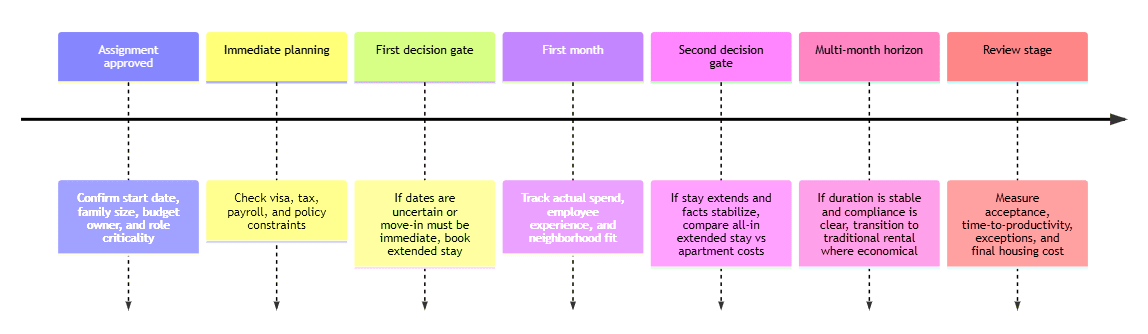
That sequence is what makes phased housing the new standard in corporate relocation housing. Not because apartments are obsolete, and not because extended stays are always cheaper, but because uncertainty is now expensive. The best corporate relocation housing policy buys flexibility first and locks in residential efficiency later. That is ultimately the most rigorous answer to the extended stay vs apartment question.

Related Stories


